Practitioner Profile · CSR
Depth Over Display: Gayatri Subramaniam on Shaping India’s CSR Landscape
A biographical reflection on one of the practitioners who witnessed — and helped shape — the evolution of corporate social responsibility in India, and who serves as an advisor to KairoPact on CSR.
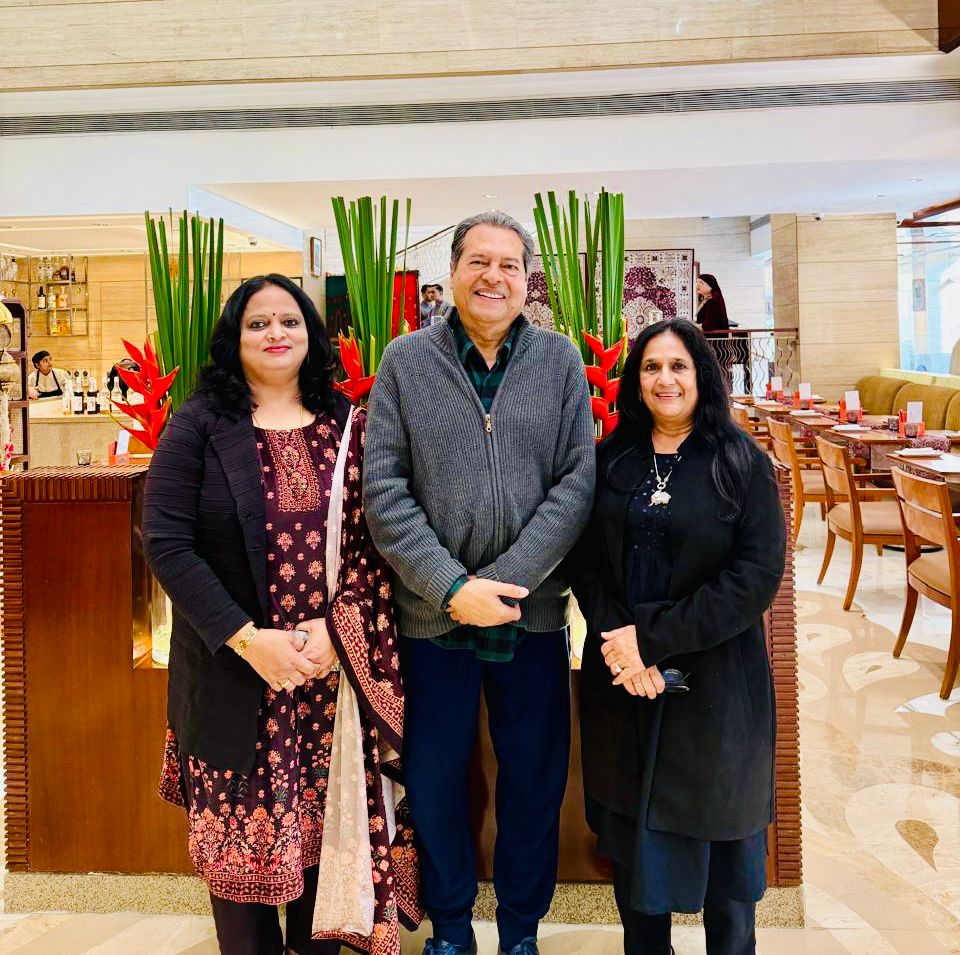
Gayatri (left) with Dr. Bhaskar Chatterjee, fondly referred to as the 'Father of Indian CSR and Sustainability.' Dr. Chatterjee, IAS, served as Director General and CEO of the Indian Institute of Corporate Affairs and was Gayatri's immediate boss during her posting there.
Some careers are built inside moments of institutional change. And Gayatri Subramaniam’s journey belongs firmly there.
It follows the story of India’s CSR evolution from an insider’s perspective, being part of major milestones that shaped the country’s corporate responsibility landscape: the early policy consultations, the emergence of formal CSR guidelines, the rewriting of the Companies Act framework, and the long effort to translate legal mandate into meaningful practice. She was part of that world as a practitioner working across government, corporate systems, and the wider social impact ecosystem.
View from the Inside
Gayatri’s early work placed her close to the institutional processes that helped bring CSR into formal corporate language in India. From the Indian Institute of Corporate Affairs to the consultative environment surrounding the new Companies Act, she witnessed how CSR moved from broad intent to a more structured national framework. She recalls those years as a period when India was not merely adjusting regulation, but rethinking what responsible business should look like in practice.
Bridging Policy and Practice
Gayatri’s perspective is especially valuable because she has worked on all sides of the equation. She has engaged with policy, advised companies, worked with civil society, and later moved into the corporate world herself, serving as CSR and Sustainability Head at HDFC Life. That combination gives her a rare vantage point: she understands both the spirit of CSR and the operational frictions that appear when institutions try to implement it.
At KairoPact, we believe execution is where intent meets reality. This is exactly why Gayatri’s depth of experience is so vital to our work — she ensures that strategy never loses sight of the human outcome.
‘Depth Over Display’ Philosophy
Throughout her journey, one conviction has remained constant: CSR should not be reduced to optics, branding, or a box-ticking exercise. She recalls that one of the earliest and biggest sources of chaos was that many companies often did not understand what CSR is. Too often, organisations tried to pass off marketing, staff engagement, or product promotion as social responsibility. For her, the real purpose of CSR was in helping marginalised communities build long-term capability but with true corporate responsibility.
CSR was never meant to be a fashion statement, a greenwashing exercise, or a sales tool. It is about building long-term capability in communities that need it most.
That is why she speaks so strongly about depth over display. A project does not become meaningful just because it creates a visible asset. A structure built is not the same as a social outcome achieved. Gayatri points to examples where companies funded infrastructure without thinking through operations, behaviour change, or long-term use. Her critique is simple: CSR must be end-to-end. It must begin with need, be implemented seriously, and be measured by whether it changes lives in durable ways.
Mindset Over Process
The most striking thing about Gayatri is not just the breadth of her experience, but the clarity of her moral position. Asked what she would most like to change, her answer is not about process or software. It is about mindset. She wants corporates to stop seeing CSR as a fashion statement, a greenwashing device, or a sales tool — and to understand its deeper purpose. That’s the kind of practitioner she is: someone who believes that while systems matter, the spirit behind them matters more.
New Frontiers
Over time, her work has expanded beyond advisory into institution-building, training, and entrepreneurship. She has remained active in capacity building, independent consulting, and initiatives such as the Association for Women in Business. She also continues to engage with new frontiers in the field, including ESG, AI, and geotagging, bringing a practical lens to how technology can strengthen implementation and accountability.
The CSR ecosystem today is more regulated, more professional, and more technologically enabled than ever before. Yet, the field still needs people like Gayatri to create clarity.
Her journey is a reminder that India’s CSR architecture was not built by law alone. It was built by practitioners who understood that responsible business requires not only compliance, but also conviction. Not just intention, but also execution.
CSR was never meant to be a fashion statement, a greenwashing exercise, or a sales tool. It is about building long-term capability in communities that need it most.
Interested in learning how Gayatri's "end-to-end" approach and KairoPact's execution infrastructure can transform your organisation's social impact strategy? Contact the KairoPact team here.